CVT Linear Motor (Linear Motor + Continuously Variable Transmission)
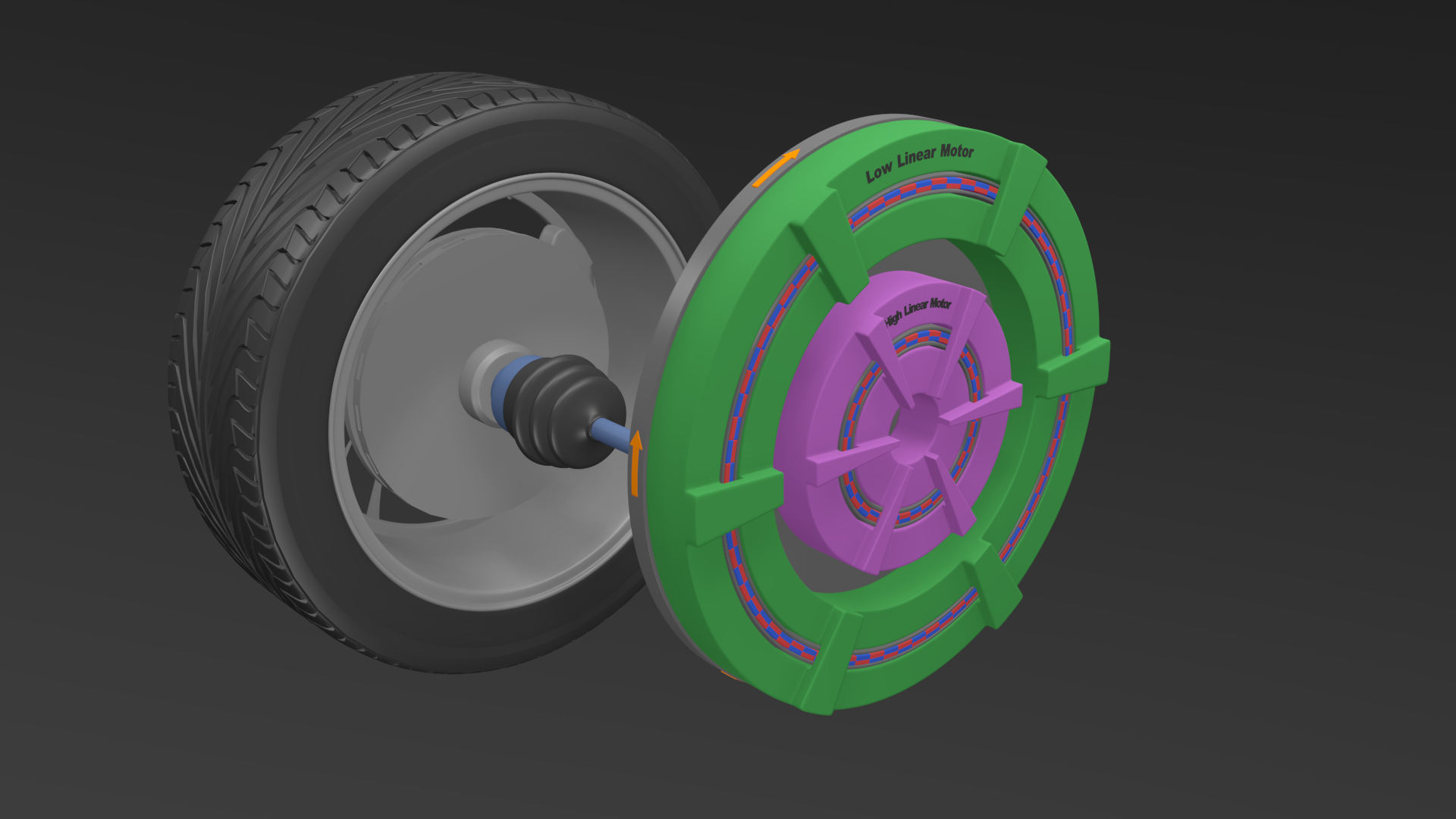


리니어 모터는 영구 자석을 일직선으로 배치하고,
영구 자석의 위에서 전류를 흘렸을 때 발생하는
전자기력을 이용한 모터이다.
이 원리는 자기부상열차에 사용된다.
영구 자석의 직선 배치를 원형으로 이어지게 만든다.
영구 자석 극의 양쪽에 리니어 모터 코일 부분을 설계한다.
이렇게 설계하여 리니어 모터가 회전하게 된다.
바깥쪽에 저단 리니어 모터,
안쪽에 고단 리니어 모터를 설계한다.
모터의 회전 속도를 제어하는 것은
리니어 모터의 코일 부분에서
전류의 흐름이 바뀌는 속도로 제어한다.
모터의 힘을 제어하는 것은
리니어 모터의 코일 부분에서
코일에 가해지는 출력으로 제어한다.
저속 회전에서는
저단 리니어 모터의 출력을 높이고,
고단 리니어 모터의 출력을 낮춘다.
고속 회전에서는
저단 리니어 모터의 출력을 낮추고,
고단 리니어 모터의 출력을 높인다.
예시를 들어 보겠다.
저속에서 저단 리니어 모터 출력 90%,
고단 리니어 모터 출력 10%이다.
고속에서 저단 리니어 모터 출력 10%,
고단 리니어 모터 출력 90%이다.
이렇게 하여 리니어 모터에서 무단변속기 설계를 했다.
에너지를 효율을 높일 수 있다.
·························································································
회전 구동력을 만드는 방법에 있어서
일반 모터의 경우 코일 부분이 회전한다.
코일 부분이 무겁기 때문에 비효율 적이다.
'CVT 리니어 모터'는 회전 구동력을 만드는 방법에 있어서
가장 효율적인 설계라고 생각된다.
나아가서 자동차의 차동 기어, 추진축까지 생략할 수 있다.
구동 시스템의 효율을 높이고, 중량을 낮춤으로써 연비 효율을 높일 수 있다.
전기차는 배터리 방전의 문제로부터 벗어날 수 없다.
전기차의 배터리 비중을 10% 이하로 낮추고
발전기와 연료로 전기를 만들어 모터를 구동하는 방식이 맞다고 생각한다.
배터리 성능과 관계 없이,
전기 모터는 기온이 떨어지면 성능 저하가 생긴다.
배터리는 '회생 제동 에너지'를 충전할 수 있다.
또한 전기 출력 안정성을 높여 발전기의 비중을 낮출 수 있다.
하지만 특수한 환경을 고려하여 배터리를 완전히 제외하여,
발전기에서 모터로 직접 전력을 공급하는 구동 시스템도 개발이 필요할 것 같다.
이 설계를 응용하여 영구 자석, 코일을 여러 단으로 만들 수 있을 것 같다.
이 설계에서는 없지만, 코일의 반대쪽에 영구 자석을 설계하는 것도 가능할 수 있다.
자동차의 개발에서 이제 내연 기관을 개발하는 것은 낭비라고 생각한다.
수소 연료 전지는 '백금'이 촉매제로 사용되는데 굉장히 고가이다.
'백금'을 대체할 촉매제는 아직 개발되지 못한 것 같다.
수소 폭발 엔진은 수소를 연료로 실린더 내에서 폭발시켜 동력을 얻는 내연기관이다.
수소 폭발 엔진은 '백금'이 사용되지 않는 것 같다.
수소 폭발 엔진을 'CVT 리니어 모터'의 발전기로 사용하면
완전한 친환경 자동차로 개발할 수 있을 것 같다.
-----------------------------------------------------------------------------------------
CVT Linear Motor
(Linear Motor + Continuously Variable Transmission)
A linear motor utilizes the electromagnetic force generated
when a current flows over permanent magnets arranged in a straight line.
This principle is used in magnetic levitation trains.
The permanent magnets are arranged in a straight line, forming a circle.
The linear motor coils are designed on either side of the permanent magnet poles.
This design allows the linear motor to rotate.
Design a low linear motor on the outside
and a high linear motor on the inside.
Controlling the motor's rotational speed is achieved by controlling
the rate at which the current flow changes in the coil section of the linear motor.
Controlling the motor's power is achieved by controlling
the output applied to the coil in the linear motor's coil section.
At low speeds,
the output of the low linear motor is increased,
and the output of the high linear motor is decreased.
At high speeds,
the output of the low linear motor is decreased,
and the output of the high linear motor is increased.
Here's an example.
At low speeds, the low linear motor output is 90%, and the high linear motor output is 10%.
At high speeds, the low linear motor output is 10%, and the high linear motor output is 90%.
This is how I designed a CVT for a Linear motor.
It can improve energy efficiency.
·························································································
In terms of generating rotational power,
in a typical motor, the coil rotates.
This is inefficient because the coil is heavy.
The 'CVT Linear motor' is considered the most efficient design for generating rotational power.
Furthermore, it can eliminate the vehicle's differential gear and propeller shaft.
By increasing the efficiency of the drive system and reducing weight, it can improve fuel efficiency.
Electric vehicles cannot escape the problem of battery discharge.
I believe the right approach is to reduce the battery's proportion to less than 10%
and use a generator and fuel to generate electricity to drive the motor.
Regardless of battery performance,
electric motors experience a performance degradation when temperatures drop.
Batteries can be recharged using 'regenerative braking energy'.
It can also increase electrical output stability, reducing the need for a generator.
However, considering special circumstances,
it seems necessary to develop a drive system that completely eliminates the battery
and supplies power directly from the generator to the motor.
By applying this design, it seems that
permanent magnets and coils can be made in multiple stages.
Although not shown in this design,
it might also be possible to design a permanent magnet
on the opposite side of the coil.
In the development of automobiles,
I now think that developing internal combustion engines is a waste.
Hydrogen fuel cells use 'Platinum' as a catalyst, which is extremely expensive.
It appears that a catalyst to replace 'Platinum' has not yet been developed.
A hydrogen explosion engine is an internal combustion engine
that generates power by exploding hydrogen fuel inside a cylinder.
It seems that 'Platinum' is not used in hydrogen explosion engines.
Using a hydrogen explosion engine as a generator
for a 'CVT Linear Motor' could potentially lead
to the development of a completely eco-friendly vehicle.
'Gallery > 꿈의 전시관' 카테고리의 다른 글
| 축구장 모듈 그라운드 (Soccer field : Module Ground) (0) | 2025.04.13 |
|---|---|
| 페블 플립 폰 (Pebble Flip Phone) (0) | 2024.10.20 |
| 급발진 억제 페달 설계 (액셀, 브레이크) (0) | 2024.04.26 |
| 에어리스 압전 바퀴 설계 (Airless Piezoelectric Tire) (0) | 2022.12.25 |
| 광학 100배 폴디드 줌 카메라 설계 (0) | 2021.09.07 |


